

Why AI Self Service Succeeds or Fails in Public Spaces
AI self service is promoted as cutting-edge technology. In public environments, success depends on something simpler: whether people can use it immediately without training or instruction.
Most visitors do not want to navigate menus or read long prompts. They want to ask a question, receive a clear answer, and continue on their way.
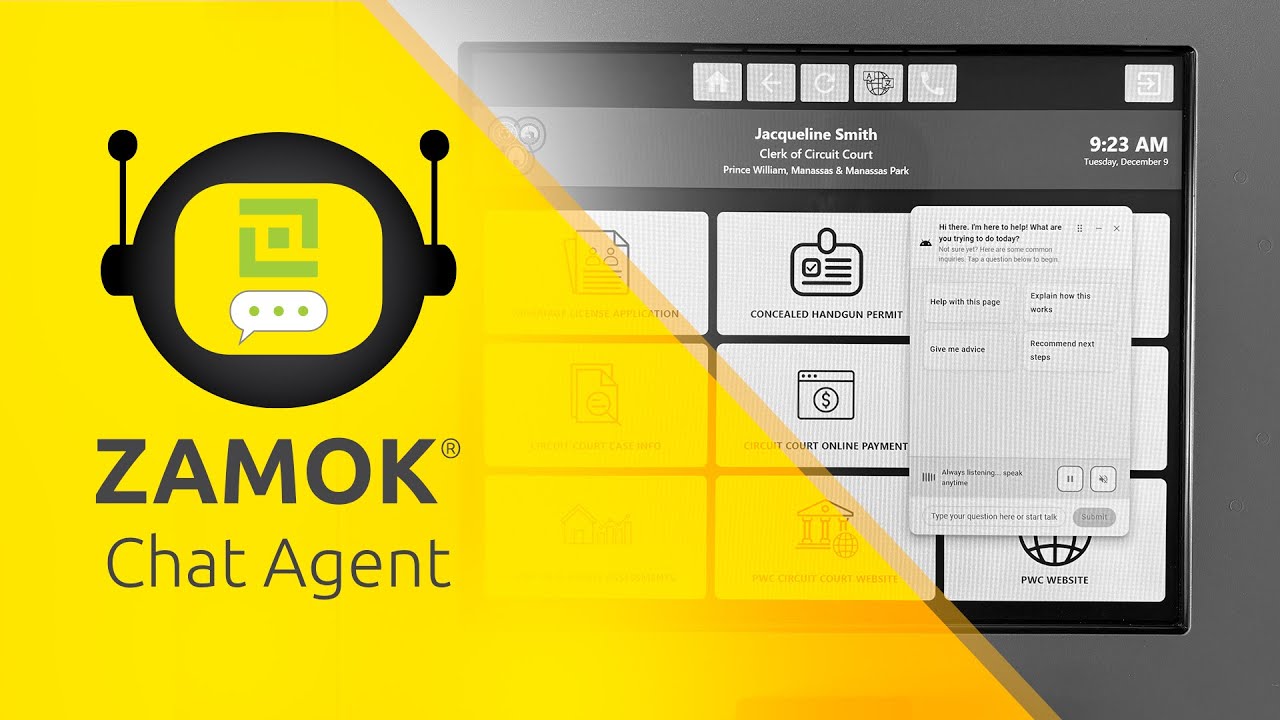
The Zamok Chat Agent brings conversational AI to self service kiosks, making access faster and more intuitive for the public while reducing strain on front desk staff.
Replacing Menus with Conversation
Traditional self service kiosks depend on visual navigation. While effective in some situations, layered menus and button-driven workflows can slow people down and create uncertainty, especially in busy or unfamiliar environments.
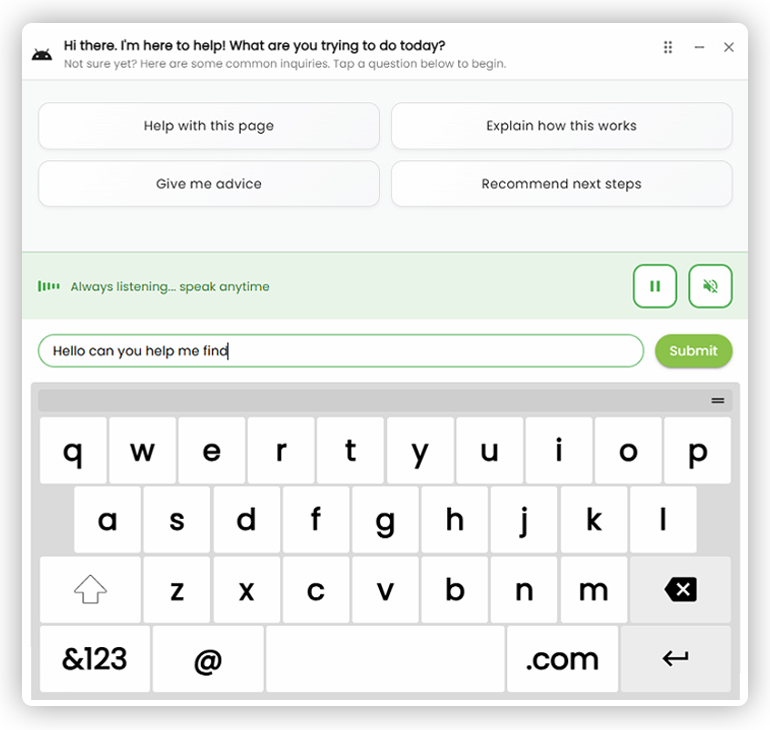
With the Zamok Chat Agent, visitors simply speak or type. The system listens, understands intent, and routes them directly to the right service. That may be a form, a payment process, an appointment check in, or an information request.
This is AI self service designed around how people naturally ask for help.
Example: A Typical Interaction
 A visitor entering a police station might simply say, “I need to file a vehicle crash report.”
The Zamok Chat Agent can guide them directly to the appropriate report form, explain what information is required, and walk them through the submission process without the need for front desk assistance.
In just a few steps, the visitor completes the task while staff remain focused on higher-priority responsibilities. In just a few steps, the visitor completes the task while staff remain focused on higher-priority responsibilities.
Designed for the Realities of Public Use
Public buildings are noisy, diverse, and unpredictable. AI systems must adapt to those conditions to be effective.
The Zamok Chat Agent is built specifically for public-facing environments and supports:
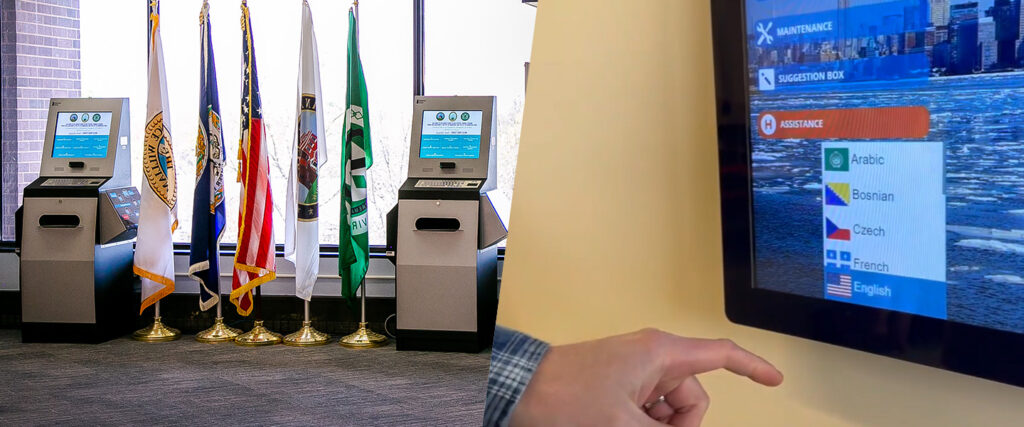
- Automatic language detection and multilingual interaction
- On-screen translation to support accessibility
- Noise awareness with optional handset use
- Clear, direct responses that keep interactions moving
These capabilities help ensure reliable service in lobbies, service counters, and high traffic areas where visitors need quick guidance.
Where AI Self-Service Works Best
Public service environments are very different from websites. Visitors may be stressed, unfamiliar with the building, or unsure where to start. AI technology must adapt to that environment and provide clear guidance within seconds.
In public-facing kiosks, conversational AI is most effective when applied to practical tasks such as:
- Answering frequently asked questions
- Guiding visitors to the correct service or form
- Translation and multilingual communication
- Improving accessibility for individuals who may need additional assistance
When used in these ways, AI becomes a practical tool that improves clarity, reduces confusion, and helps visitors complete services more efficiently.
Onboarding That Makes AI Self Service Achievable
AI tools are powerful only when they are implemented correctly. That process begins long before the technology is actually deployed.
Too often, organizations procure AI technology and are left to train models, define logic, and manage tuning internally. What begins as a promising initiative quickly becomes a long and resource-heavy project.
The Zamok Chat Agent follows a different path. Every deployment is supported by Advanced Kiosks’ onboarding service. Our team works with customers to define services, structure responses, map spoken requests to real workflows, and create clear guardrails for public use.
Customers do not need to become AI experts. Advanced Kiosks leads configuration, validates behavior, and ensures the chat agent is ready for live interaction.
AI With Oversight and Accountability
The AI capabilities behind the Zamok Chat Agent operate within the Zamok platform, the software environment that powers all Advanced Kiosks systems, including the Greeter Visitor Management System and the Kiosk Office Suite.
Because AI is integrated at the platform level, agencies can deploy conversational assistance consistently across multiple kiosks and services while maintaining centralized oversight and control.
Equally important is visibility. Agencies need to understand how AI is interacting with the public.
Through Zamok, administrators can review AI conversations, analyze patterns across hundreds of kiosk sessions, and identify where visitors may be encountering confusion or delays. These insights allow agencies to refine responses, improve workflows, and ensure the system continues to serve the public accurately.
This transparency ensures AI is not a black box, but a system that can be monitored, improved and managed responsibly.
Watch How AI Simplifies Self Service and Streamlines the Visitor Experience:
The goal is not to replace human staff; it’s to reduce friction around routine requests. This approach allows agencies to adopt AI self service with confidence and without added operational burden.
By handling common questions and guiding visitors to the right service on the first attempt, the Zamok Chat Agent helps:
- Reduce congestion at service counters
- Improve clarity and speed for visitors
- Free staff to focus on complex or sensitive needs
The result is better service for the public and more manageable workloads for teams.
A Practical Path Forward for AI Self Service
In public sector environments, the most successful AI solutions are the ones that work quietly and reliably in the background.
The Zamok Chat Agent delivers an experience that is conversational, accessible, and operationally grounded, supported by onboarding that removes deployment risk and keeps configuration manageable.
For organizations exploring AI self service, this creates a clear path forward, faster access for the public, less strain on staff, and a system designed for real world use.
Learn more at AdvancedKiosks.com or connect with a solutions expert to discuss your use case.