Select Page

The Smart Police Station: Transforming How Agencies Serve the Public

  1. Home
  2. Solutions & Industries
  3. Smart Police Station

Deliver faster, more accessible services with fewer resources.

Police departments across the country are under pressure to deliver faster, more accessible services with fewer resources. The smart police station is an emerging model that combines self-service kiosks, digital workflows, visitor management, and AI-guided assistance to modernize how agencies handle walk-in traffic, without adding staff.

Rather than replacing officers, a smart police station extends their capacity. Routine tasks like records requests, permit applications, incident report submissions, and payments shift to guided self-service systems. Staff stay focused on complex cases and community safety while citizens get faster, more consistent service around the clock.

Advanced Kiosks provides the complete technology platform behind smart police stations deployed at agencies nationwide, including the Decatur Police Department (Texas) and the Itasca County Sheriff’s Office (Minnesota).

Featured in IACP Police Chief Magazine banner
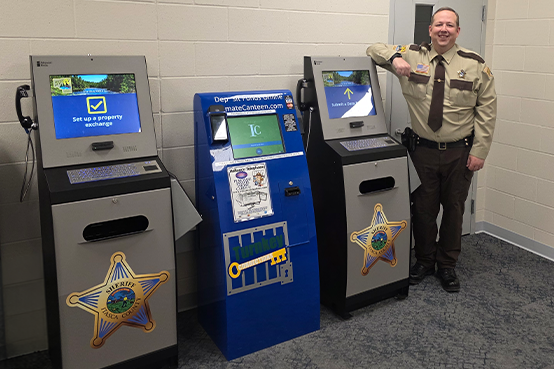
Itasca County Sheriff's Office Smart Police Station Self Service Kiosk
Decatur Police Department
Greeter visitor management system for law enforcement
Kiosk Office Suite for Law Enforcement
Wall mounted kiosk at Police Dept
Woman using kiosk in police station
Man checking into police station on kiosk
Wall Mounted Law Enforcement Kiosk in use
Police station kiosk in use
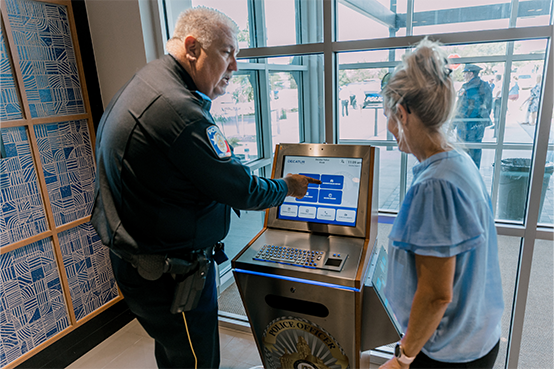
Police officer instructing kiosk user in a Smart Police Station
Women using police kiosk
Citizen using smart police station kiosk
Users in front of police kiosk
Residents using self-service kiosks
Itasca County resident interacting with the Kiosk Office Suite
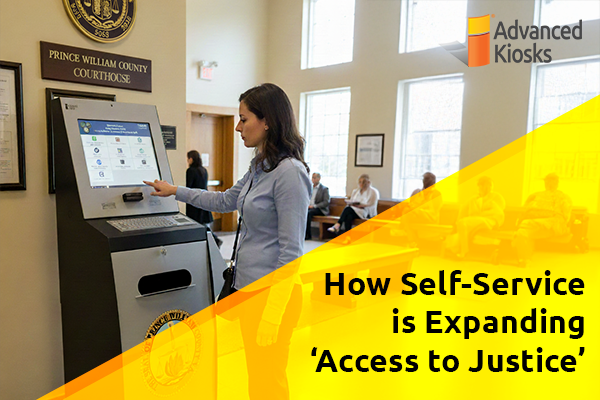
Law Enforcement self service kiosk station

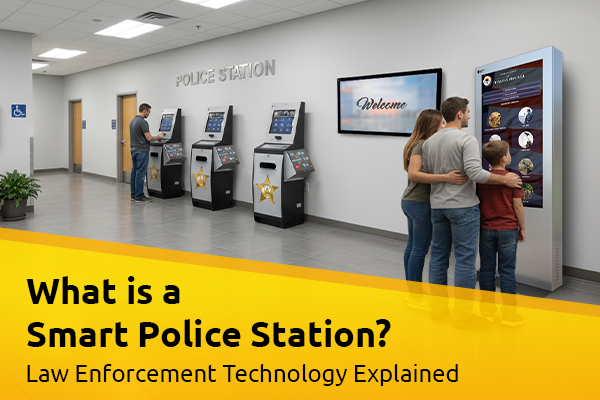
What Is a Smart Police Station?

A smart police station is a law enforcement facility that uses self-service technology, digital workflows, and AI-guided assistance to deliver public services more efficiently.

Instead of routing every visitor through a staffed front desk, a smart police station provides multiple digital touchpoints that allow citizens to complete routine tasks independently, from filing reports and requesting records to paying fines and checking in for appointments.

The concept isn’t about unmanned facilities or removing officers from the equation. In the US, a smart police station means modernizing the lobby experience so that officers and administrative staff are freed from repetitive transactions and can focus on higher-value work.

Core elements of a smart police station include:

  • Self-service kiosks for forms, documents, reports, and payments
  • Visitor management systems for secure check-in, badge printing, and lobby flow
  • AI-guided assistance that helps citizens navigate services, answer common questions, and complete multi-step processes
  • Digital forms and workflow automation that replace paper, reduce errors, and route submissions to the right department instantly
  • Remote management software that lets administrators monitor, update, and secure all kiosk systems from a central dashboard

The Problem: Why Traditional Police Lobbies Fall Short

Most police departments are dealing with the same set of operational pressures. Walk-in demand hasn’t decreased. If anything, rising expectations from the public, shaped by digital experiences in every other sector, have made the gap between what citizens expect and what a traditional front desk can deliver wider than ever.

Common challenges:

  • Front desk bottlenecks during peak hours, with a single point of service for every type of request
  • Repetitive administrative tasks, permit applications, records requests, payment processing, consuming staff hours
  • Paper-based forms that lead to incomplete submissions, illegible handwriting, and manual re-entry
  • Visitors who arrive unsure which form to fill out, which department to visit, or which documents to bring
  • Limited or no service availability outside standard business hours
  • Staffing constraints that force departments to choose between lobby coverage and patrol duties

These are not new problems, but they are becoming harder to manage. A smart police station addresses them systematically rather than incrementally.

Core Components of a Smart Police Station

Building a smart police station doesn’t require a new facility. It requires rethinking how services are delivered within the existing one. The following technology components form the foundation.

Self-Service Kiosks

Self-service kiosks are the operational backbone of a smart police station. Positioned in the lobby or public-facing areas, they allow citizens to complete tasks that would otherwise require staff assistance: submitting incident reports, requesting accident or police reports, applying for permits, paying fines or fees, scanning and printing documents, and accessing government databases.

Each kiosk guides users through structured digital workflows step by step, reducing errors and ensuring that submissions are complete before they reach staff. With 24/7 availability, kiosks extend service hours beyond what a staffed counter can provide.

Solution: Kiosk Office Suite

Police officer instructing kiosk user

Visitor Management Systems

Managing who enters a police facility is both a service and a security function. A visitor management system digitizes the check-in process: visitors sign in, provide identification, receive a printed badge, and are directed to the appropriate service area, all without requiring staff at the front desk.

The system maintains a real-time log of everyone in the building, sends automated notifications to staff when visitors arrive, and enforces facility policies consistently. For law enforcement environments, this creates an audit-ready record of all lobby traffic.

Solution: Greeter Visitor Management System™ 

Law Enfocement Officers_GVMS CTA Button
Easier Navigation with the Greeter Wayfinding Kiosk Feature

AI-Guided Workflows

One of the biggest friction points in a police lobby is confusion. Citizens often don’t know which service they need, which form to fill out, or what documents to bring. AI-guided assistance addresses this by providing real-time, plain-language help at the point of service.

AI can answer common questions (“How do I get a copy of a police report?”), help users determine the correct service path, walk them through multi-step processes, and flag incomplete submissions before they reach staff. This reduces repeat visits, cuts down on errors, and ensures that the intake process is consistent regardless of which citizen is at the kiosk.

For departments concerned about transparency, advanced systems include administrative tools that allow staff to review AI interactions, analyze patterns, and improve responses over time. AI operates as a guided layer — not a black box.

Solution: Zamok™ Kiosk Management Software with AI Assistant

Zamok Kiosk Management Software
Zamok-VoIP-Calling-Active-Call

Session Security

In a law enforcement environment, securing public-facing kiosk sessions is critical. FaceLock uses facial detection to ensure that a kiosk session is being used by one person at a time. If the original user walks away, the session automatically resets, preventing unauthorized access to in-progress forms, personal data, or sensitive submissions.

This is particularly important for smart police stations where kiosks handle permit applications, records requests, and document submissions that may contain personally identifiable information. FaceLock provides a layer of security without requiring staff to monitor each kiosk manually.

Feature: FaceLock™ Security

FaceLock-graphic

Digital Forms and Document Processing

Paper forms are the single biggest source of administrative friction in police lobbies. They’re illegible, incomplete, and require manual data entry. Digital form processing replaces this with structured, validated intake: citizens complete forms on-screen with field-level validation, built-in instructions, and automatic routing to the correct department.

Completed forms generate clean PDFs, are transmitted securely, and integrate with existing records management systems. Multi-language support ensures accessibility for non-English-speaking community members.

Feature: Zamok eForms Assistant

Paperforms vs Eforms

Real-World Deployments

Itasca County Sheriff’s Office, Minnesota

The Itasca County Sheriff’s Office deployed the Kiosk Office Suite to modernize permit-to-carry applications, document submissions, and routine service requests. In the first six months, the kiosks processed hundreds of transactions that previously required handwritten forms and staff-assisted intake.

The deployment reduced front-desk workload, improved data accuracy (eliminating illegible handwriting), and provided the department with a consistent, auditable intake process.

Decatur Police Department, Texas

When the Decatur Police Department built a new headquarters, they designed the facility around the smart police station model from day one. The department deployed two coordinated self-service systems from Advanced Kiosks: a Greeter Visitor Management System at the entrance and a Kiosk Office Suite station for forms, payments, and service requests.

The result was a lobby where citizens could check in, understand their next step, and complete routine transactions independently. Staff were freed from repetitive front-desk interactions and could focus on complex cases and direct community engagement.

What Is a Smart Police Station?

A smart police station is a law enforcement facility that uses self-service technology, digital workflows, and AI-guided assistance to deliver public services more efficiently.

Instead of routing every visitor through a staffed front desk, a smart police station provides multiple digital touchpoints that allow citizens to complete routine tasks independently, from filing reports and requesting records to paying fines and checking in for appointments.

The concept isn’t about unmanned facilities or removing officers from the equation. In the US, a smart police station means modernizing the lobby experience so that officers and administrative staff are freed from repetitive transactions and can focus on higher-value work.

Core elements of a smart police station include:

  • Self-service kiosks for forms, documents, reports, and payments
  • Visitor management systems for secure check-in, badge printing, and lobby flow
  • AI-guided assistance that helps citizens navigate services, answer common questions, and complete multi-step processes
  • Digital forms and workflow automation that replace paper, reduce errors, and route submissions to the right department instantly
  • Remote management software that lets administrators monitor, update, and secure all kiosk systems from a central dashboard

The Problem: Why Traditional Police Lobbies Fall Short

Most police departments are dealing with the same set of operational pressures. Walk-in demand hasn’t decreased. If anything, rising expectations from the public, shaped by digital experiences in every other sector, have made the gap between what citizens expect and what a traditional front desk can deliver wider than ever.

Common challenges:

  • Front desk bottlenecks during peak hours, with a single point of service for every type of request
  • Repetitive administrative tasks, permit applications, records requests, payment processing, consuming staff hours
  • Paper-based forms that lead to incomplete submissions, illegible handwriting, and manual re-entry
  • Visitors who arrive unsure which form to fill out, which department to visit, or which documents to bring
  • Limited or no service availability outside standard business hours
  • Staffing constraints that force departments to choose between lobby coverage and patrol duties

These are not new problems, but they are becoming harder to manage. A smart police station addresses them systematically rather than incrementally.

Measurable Outcomes

Departments that have adopted the smart police station model report consistent operational improvements across several dimensions.

Outcome How It’s Achieved
Reduced front-desk workload Routine requests shift to kiosks, giving staff uninterrupted time for higher-priority responsibilities.
Faster citizen service Self-service eliminates wait times for common transactions. Citizens complete tasks at their own pace.
Improved data accuracy Structured digital forms with field validation replace handwritten, illegible paper submissions.
Extended service hours Kiosks operate 24/7, providing access to services outside traditional business hours.
Better lobby flow Visitor management systems direct traffic, reduce confusion, and provide real-time facility awareness.
Reduced repeat visits AI guidance ensures submissions are complete and correct the first time, minimizing follow-up.
Audit-ready records Every interaction is digitally logged with timestamps, creating compliance-ready documentation.
CPARS

Our Latest Contractor Performance Assessment Reporting System (CPARS) Evaluation:

  • QUALITY: Exceptional
  • SCHEDULE: Very Good
  • COST CONTROL: Very Good
  • MANAGEMENT: Exceptional
  • SMALL BUSINESS SUBCONTRACTING: Exceptional
The CPARS rating is used in part to document contractor performance on federal awards. According to the CPARS website, that information includes “the contractor’s record of conforming to requirements and to standards of good workmanship; forecasting and controlling costs; adherence to schedules, including the administrative aspects of performance; reasonable and cooperative behavior and commitment to customer satisfaction; reporting into databases; integrity and business ethics; and business-like concern for the interest of the customer.”

READ MORE

How to Get Started

Building a smart police station does not require a new facility, a large budget, or a full technology overhaul. Most agencies begin with one or two high-impact workflows and expand as results appear.

  1. Identify your highest-friction processes. Common starting points include permit applications, crash report requests, records requests, lobby check-in, and payment collection.
  2. Map the workflow. Define the steps, required documents, and routing so the kiosk can handle the work that currently burdens staff.
  3. Deploy incrementally. Start with a single lobby kiosk or one digital workflow. Measure usage and citizen adoption before expanding.
  4. Integrate visitor management. Add a Greeter system to coordinate lobby flow, enforce policies, and provide real-time awareness of facility traffic.
  5. Add AI guidance. Layer in AI-assisted workflows to reduce confusion, answer common questions, and ensure complete submissions.
  6. Review and expand quarterly. Adjust workflows as department needs evolve. Add new services, locations, or kiosk units based on measured outcomes.

Talk to Us About Your Station 

Every smart police station starts with a single conversation.

Contact Advanced Kiosks to discuss your department’s needs. We’ll help you identify the highest-impact workflows, recommend the right configuration, and provide a complete implementation plan — from hardware and software to installation and training.

📞 (603) 865-1000

✉️ sales@advancedkiosks.com

🔗 advancedkiosks.com/contact/

Frequently Asked Questions (FAQ)

Q: What is a smart police station?

A smart police station is a law enforcement facility that uses self-service kiosks, digital workflows, visitor management systems, and AI-guided assistance to deliver public services more efficiently. Instead of routing all visitors through a staffed front desk, routine tasks are handled through guided digital systems that operate 24/7.

Q: Does a smart police station replace officers?

No. A smart police station extends staff capacity by shifting routine administrative tasks to self-service technology. Officers and administrative personnel are freed to focus on complex cases, community engagement, and public safety rather than repetitive paperwork and transactions.

Q: What services can citizens access at a smart police station?

Common services include filing incident reports, requesting police or accident reports, submitting permit applications, paying fines and fees, scanning and printing documents, and checking in for appointments. The specific services available depend on the department’s configuration.

Q: How much does it cost to build a smart police station?

Most departments begin with a single kiosk deployment starting at approximately $25,000 and expand based on results. A smart police station does not require a new building, it’s a technology layer added to your existing facility. Costs scale with the number of kiosks, software features, and services deployed.

Q: Is the technology secure enough for law enforcement environments?

Yes. Systems from Advanced Kiosks use end-to-end encryption, secure authentication, and CJIS-aligned data handling practices. All kiosk submissions are digitally logged with timestamps, and the Zamok management platform provides remote monitoring and security controls.

Q: Do I need a new building to create a smart police station?

No. Smart police station technology can be deployed in any existing facility. Most agencies start by placing one or two kiosks in the lobby and adding visitor management at the entrance. The technology adapts to your current space and can be expanded over time.

Q: What is the difference between a smart police station and a regular police station with kiosks?

A kiosk is a single tool. A smart police station is an integrated model that coordinates self-service kiosks, visitor management, AI guidance, and digital workflows into a cohesive service delivery system. The difference is between adding a piece of technology and rethinking how the lobby operates.

Get Expert Guidance for Your Perfect Law Enforcement Kiosk Solution!

law enforcement kiosk interface sample

From Our Blog

Speak with a Specialist