Walk-in traffic at police departments hasn’t slowed down. If anything, it continues to grow.
Records requests, incident reports, background checks, permits, payments, and general inquiries all funnel through the same front desk. At the same time, departments are managing staffing constraints and increasing expectations from the public.
The result is familiar. Long wait times, frequent interruptions for staff, and a steady flow of repetitive administrative work.
To address this, many agencies are rethinking how their facilities operate. Instead of relying solely on a staffed counter, they are introducing new law enforcement technology solutions that improve how the public accesses services.
This shift has led to the emergence of what’s often referred to as a smart police station.
In many cases, these improvements are not limited to digitizing forms. Departments are also beginning to explore guided assistance, including AI-supported tools that help visitors understand and complete services more efficiently.
What Is a Smart Police Station?
A smart police station is not defined by the building itself. It is defined by how services are delivered.
At its core, it is a model that combines physical space with technology to improve access, streamline workflows, and reduce reliance on manual processes.
It represents a shift in how police department technology is used to support daily operations and public service delivery.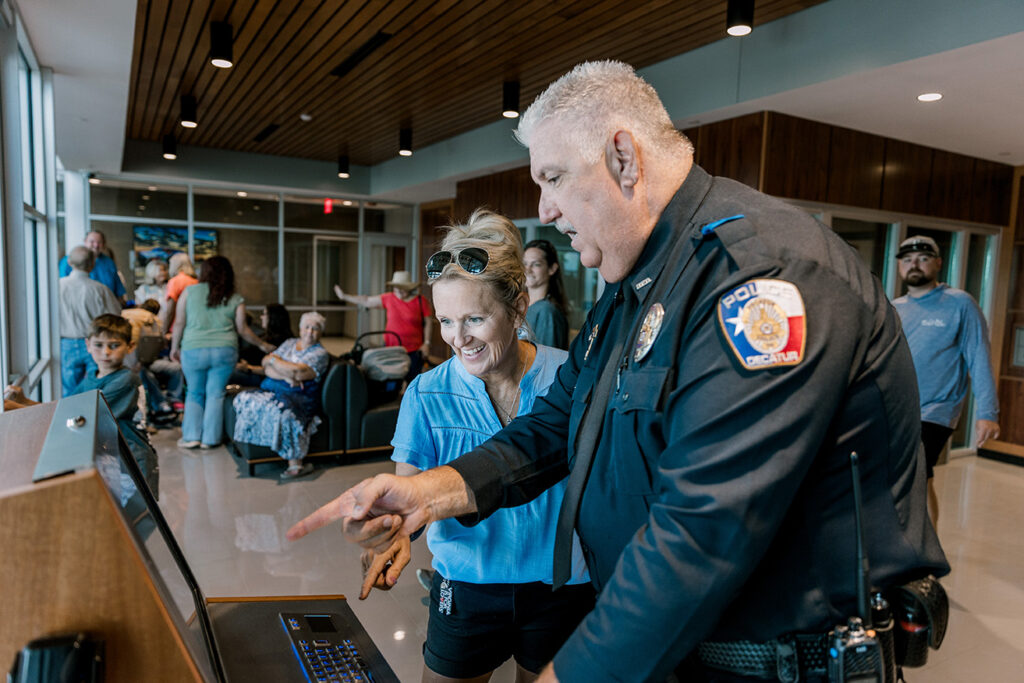
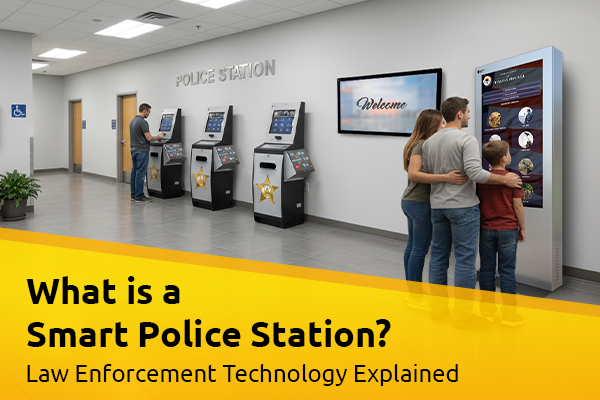
In a smart police station, routine services are no longer handled exclusively by staff at a counter. Instead, they are supported by:
- Self-service access points for common tasks
- Guided digital workflows that walk users through processes step by step
- Optional AI-assisted guidance to help users navigate services and answer common questions
- Multiple service touchpoints throughout the facility, not just a single front desk
This approach allows departments to serve more people, more efficiently, without increasing staffing requirements.
The Challenges Police Departments Face
Most departments are dealing with the same operational pressures.
Administrative demand continues to rise. Walk-in services remain essential for many members of the public, especially those without reliable access to technology. At the same time, internal resources are limited.
Common challenges include:
- Front desk bottlenecks during peak hours
- Repetitive, time-consuming administrative tasks
- Paper-based forms that require manual entry and review
- Interruptions that pull staff away from higher-value work
- Limited ability to offer services outside standard hours
Another challenge is simply helping visitors understand what they need to do. Many arrive unsure of which form to complete or which service applies to their situation. Without guidance, this often leads to incomplete submissions, repeat visits, or additional staff involvement.
These issues are not new, but they are becoming harder to manage as expectations increase.
Departments are looking for ways to maintain service levels without adding strain to their teams.
The Role of Self-Service Technology
Self-service technology is becoming a practical way to extend service capacity without expanding staff.
In a smart police station, technology is used to handle routine interactions while keeping staff available for situations that require judgment or escalation.
Common components include:
Self-Service Kiosks
Self-service kiosks, often referred to as police kiosks, allow visitors to complete tasks such as submitting reports, requesting records, filling out forms, or making payments. See how these systems work in a smart police station
These systems guide users through each step, reducing errors and ensuring consistent data collection.
Digital Forms and Workflow Automation
Instead of paper forms, departments can use structured digital workflows that standardize how information is collected and processed. This reduces manual handling and improves accuracy.
Visitor Management Systems
Check-in systems help manage foot traffic, direct visitors to the right service, and maintain visibility into who is in the building.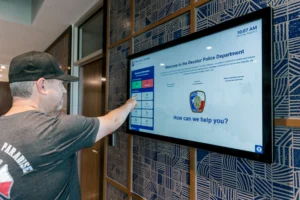
Guided Assistance and AI Support
Some departments are beginning to incorporate AI-supported tools that provide real-time guidance during the service process. These tools can answer common questions, help users select the correct service, and walk them through each step.
When implemented correctly, this reduces confusion at the point of service and helps ensure that submissions are complete and accurate before they reach staff.
Together, these tools create a more organized and predictable environment for both staff and the public.
Real-World Example: Decatur Police Department
The shift toward smart police stations is already happening.
 In Decatur, Texas, the police department implemented a new facility designed with public access and efficiency in mind. Rather than relying solely on a traditional front desk, the department introduced self-service options that allow visitors to complete common tasks independently.
Visitors can check in, submit information, and access services without waiting for staff availability. This reduces congestion in the lobby and allows personnel to focus on more complex responsibilities.
As departments adopt these systems, many are also evaluating how guided assistance and AI can further streamline the experience.
This type of deployment reflects a broader trend. Departments are not replacing staff. They are using technology to support them and improve how services are delivered.
Benefits for Departments
Departments that adopt this model are seeing measurable operational improvements.
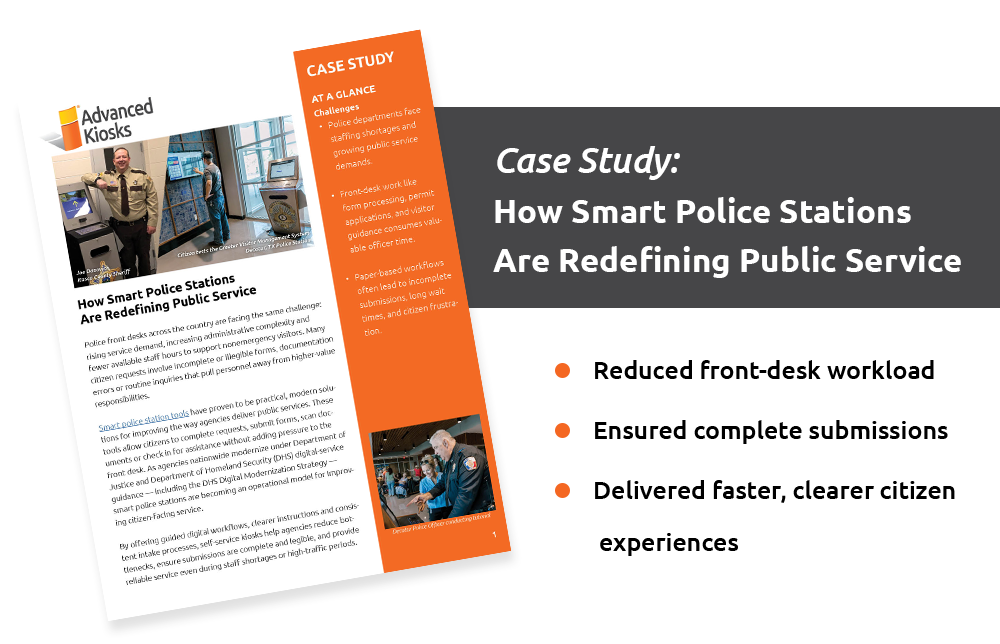 Reduced front desk workload
- Faster service for the public
- More consistent data collection
- Extended service availability
- Better use of staff time
- Reduced confusion and fewer incomplete submissions through guided, AI-supported assistance
This approach expands self-service for law enforcement without increasing staffing requirements.
These outcomes are not theoretical. They are the result of rethinking how services are delivered within the facility.
The Future of Smart Police Stations
The concept of the smart police station is still evolving, but the direction is clear.
Departments are moving toward hybrid service models that combine in-person support with structured self-service. As expectations increase, agencies are looking for ways to deliver faster, more accessible services without adding operational strain.
A key part of that evolution is the role of AI.
AI is beginning to enhance how self-service systems interact with the public. Instead of relying solely on static forms and fixed workflows, agencies can introduce guided assistance that helps users navigate processes more naturally.
For example, AI can:
- Answer common questions in plain language
- Help users determine which service they need
- Guide them through multi-step processes
- Reduce confusion before it leads to errors or staff intervention
This is especially valuable in public-facing environments where users may be unfamiliar with procedures or unsure where to start.
Equally important is visibility.
Agencies need to understand how these interactions are happening. Advanced systems provide administrative tools that allow staff to review conversations, analyze patterns across hundreds of interactions, and identify where workflows or responses need improvement.
This addresses a common concern among departments. AI should not operate as a black box. It should be measurable, reviewable, and continuously improved to ensure accuracy and accountability.
Looking ahead, smart police stations will continue to expand beyond basic self-service. They will incorporate more intelligent guidance, deeper workflow automation, and better insight into how services are used.
Departments that adopt these capabilities early will be better equipped to meet rising expectations while maintaining control over their operations.
The New Reality of Public Service Delivery
The traditional front desk model is no longer enough to meet the demands placed on modern police departments.
A smart police station provides a practical way to improve service delivery, reduce administrative strain, and make better use of existing resources.
This is not about replacing staff. It is about giving departments the tools to operate more efficiently while maintaining a high level of service for the public.
For agencies evaluating their current operations, the question is no longer whether change is needed. It is how to implement it in a way that works for their community.
To learn how Advanced Kiosks can help your department build a smart police station, visit our Smart Police Station solutions page or call (603) 865-1000.