
Five minutes of paperwork doesn’t sound like much, until it happens 30 times a day.
That’s two and a half hours of an employee’s workday spent receiving, scanning, and routing documents that residents could submit themselves. For housing authorities managing hundreds or thousands of residents, routine document intake can quietly become a major drain on staff time.
Residents arrive with identification, income documentation, applications, recertification paperwork, verification forms, and other supporting materials. Staff then have to receive those documents, scan them, determine where they belong, upload or forward them to the appropriate system or department, and often confirm that the paperwork was received.
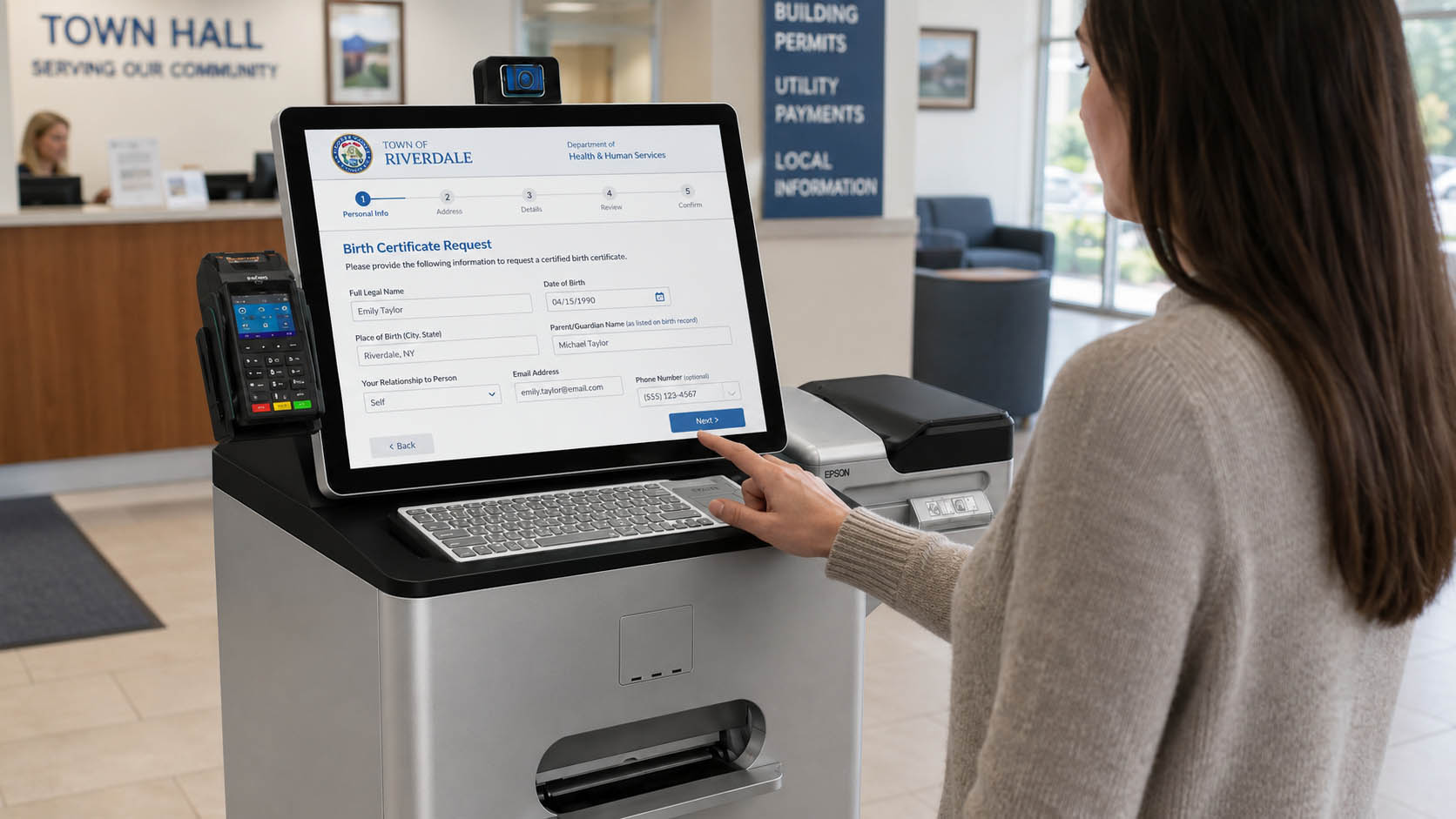
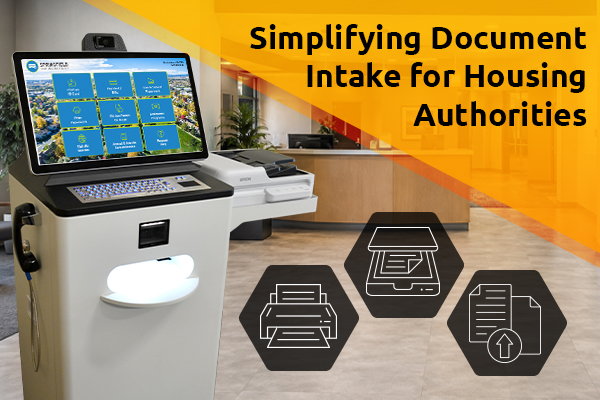
A housing authority self-service kiosk can move much of that routine document handling away from the front counter. Instead of requiring an employee to personally process every document submission, residents can use a guided document scanning kiosk to scan and submit paperwork through a controlled self-service workflow.
The goal isn’t to remove staff from the process. It’s to reserve staff time for the parts of housing administration that actually require their expertise.
Why Document Intake Becomes a Bottleneck
Housing authorities still operate in a world where digital systems and physical paperwork frequently overlap.
A resident may complete part of a process online but still need to provide a driver’s license, pay stub, bank statement, signed form or other supporting document. Another resident may arrive at the office because they do not have a scanner or reliable computer access at home.
That often leaves staff responsible for receiving the paperwork, scanning it, associating it with the correct resident, uploading or routing it to another department, and confirming whether anything else is needed. The problem is not necessarily any one step. It is the cumulative staff time required to perform these steps again and again.
For agencies already trying to reduce lobby congestion and administrative workload, improving housing authority document intake is a logical place to introduce self-service.
What a Self-Service Document Intake Workflow Looks Like
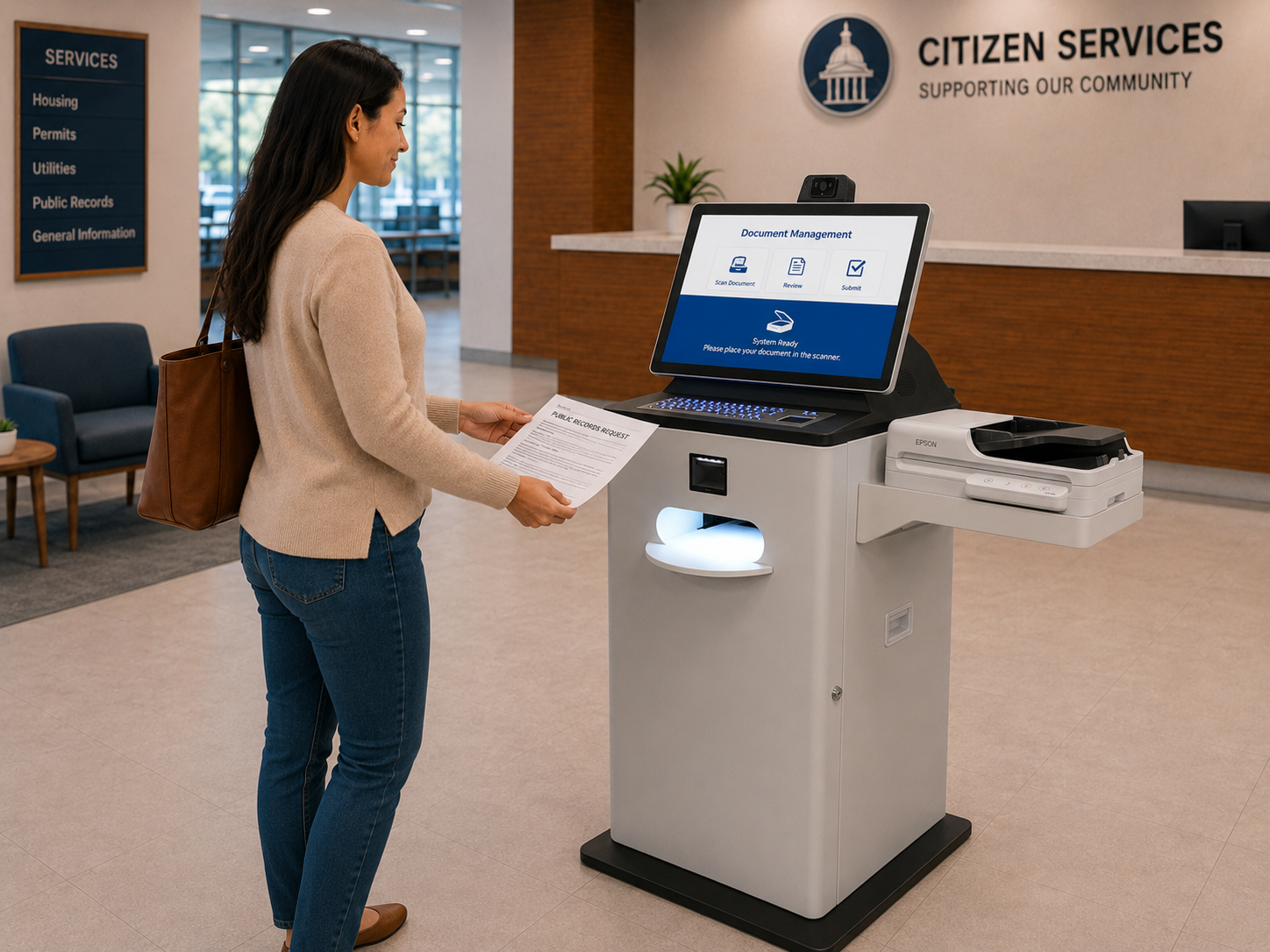
A kiosk gives residents a dedicated station where routine document submission can take place without requiring a staff member to operate the scanner.
A typical workflow might allow a resident to:
- Select the housing program or service they are working with.
- Identify themselves or enter a reference number.
- Follow instructions showing which documents are required.
- Scan one or multiple pages.
- Review the scanned documents on screen.
- Submit the documents to an approved destination.
- Receive an on-screen or printed confirmation.
The exact workflow can vary depending on the housing authority’s existing systems. In some deployments, the kiosk may send scanned files to a designated department or secure destination. In others, it can provide access to an existing document upload portal or web-based case-management application.
The workflow can also help organize submissions before they reach staff. Residents might select annual recertification, interim change, new application, income verification, identification, reasonable accommodation or general supporting documentation. The kiosk can then open the correct upload process or collect the information staff need to identify the resident and purpose of the submission.
Confirmation can be built into the same interaction. Depending on the application, residents may see a confirmation screen, receive an email or print a receipt. This gives the transaction a clearer ending and can reduce routine “Did you receive my documents?” calls and front-desk conversations.
Advanced Kiosks’ document scanning and printing kiosk solution is designed around these types of self-service workflows, including scanning, printing and submission without requiring staff to handle every transaction.
Self-Service Does Not Mean Creating Another Document System
A kiosk does not necessarily need to replace existing document collection software or a secure document upload system. In many cases, it becomes the public-facing access point to systems the agency already uses.
If a housing authority already has a browser-based resident portal, document management application or secure document upload workflow, that application may be presented through a kiosk interface. The kiosk provides residents with the hardware, scanner, touchscreen and controlled environment they may not have access to elsewhere.
This is particularly useful for agencies that have already invested in digital document intake but still find that residents frequently arrive at the office carrying physical paperwork. Instead of having staff bridge the gap between paper and the agency’s digital system, the kiosk helps residents perform that conversion themselves.
The kiosk handles the interaction. Staff handle the decision.
The Pittsburg, CA Housing Authority used a similar self-service workflow to route scanned documents to the correct housing specialist and give residents confirmation of delivery. Read more here.
Give Residents a Dedicated Place to Upload Documents
Online portals work well when residents have the necessary equipment. Not everyone does.
Uploading paperwork from home may require a computer, scanner, smartphone, internet connection and enough technical confidence to photograph or scan documents correctly. A kiosk creates a standardized submission environment inside the housing authority office or another accessible public location.
Instead of telling a resident to “go online and upload it,” the agency can provide a station with a touchscreen, document scanner, controlled browser or application, step-by-step instructions, and printing capabilities when forms or receipts are needed.
The Advanced Kiosks Document Processing Kiosk combines touchscreen access with printing and scanning capabilities for public-service workflows such as document submission.
Security Matters in Public Document Intake
Housing authority paperwork can contain sensitive personal and financial information. A public kiosk therefore needs to be more controlled than a standard computer placed in a lobby.
The kiosk should limit users to approved websites and applications, prevent access to the Windows environment, and clear session information between users.
Advanced Kiosks uses Zamok Kiosk Management Software to provide that controlled operating environment. Zamok can restrict the kiosk to approved applications, support connected peripherals such as scanners and printers, remotely manage kiosk configurations, and reset public sessions between users.
For an agency evaluating a secure document upload kiosk, those controls are just as important as the scanner itself. The objective is to create a purpose-built document intake station, not simply a shared public PC with a scanner attached.
Document Intake Can Be Part of a Larger Self-Service Strategy
Document submission rarely exists in isolation. The same resident may also need to complete an application, update information, print a form, check in for an appointment, access a resident portal, make a payment or find information about housing programs.
That is why document scanning often makes the most sense as one capability within a broader housing authority self-service strategy.
The Kiosk Office Suite is designed around the larger model: giving residents a single service point for routine transactions while reducing pressure on administrative staff and front-desk operations.
A document intake workflow may be the first use case, but the same kiosk infrastructure can support additional services over time.
Where Should Housing Authorities Place a Document Kiosk?
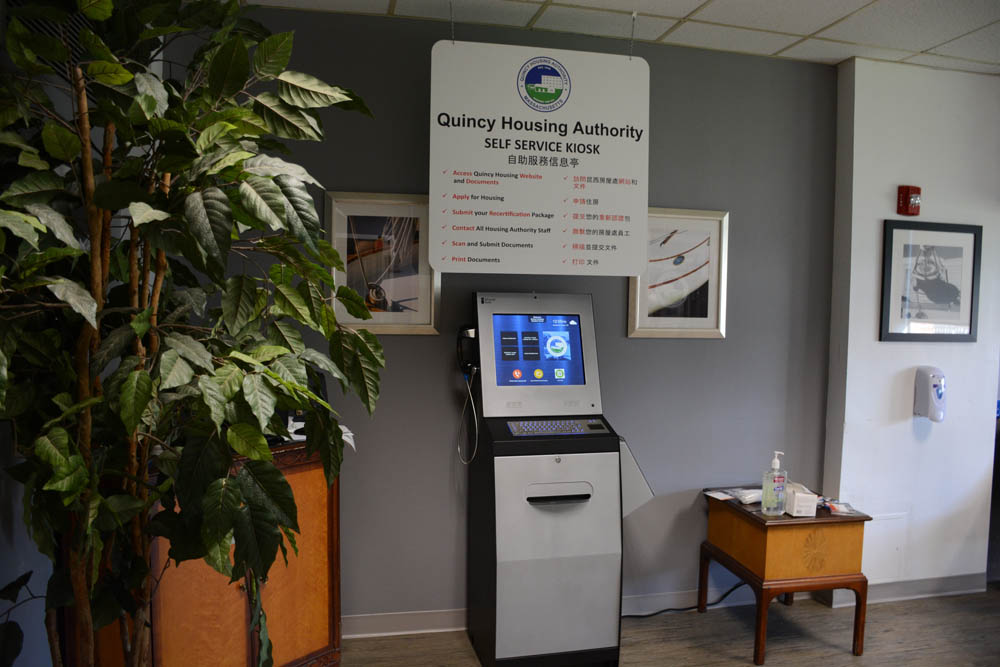
The most obvious location is the main lobby, particularly near an existing reception or resident-services area.
Self-service document intake can also be useful in:
- Property management offices.
- Satellite housing authority locations.
- Community service centers.
- Resident resource rooms.
- High-volume waiting areas.
- Locations serving multiple housing programs.
The right location depends on where residents already travel when they need to submit paperwork. The kiosk should make the existing process easier rather than requiring residents to learn an entirely new service channel.
What to Consider Before Implementing Document Intake Kiosks
Before choosing hardware, housing authorities should map the existing process from beginning to end.
Key questions include:
- What documents are residents currently bringing to staff?
Identify the most common transactions before attempting to automate everything. - Where do those documents ultimately go?
Determine whether staff upload them into a case-management system, resident portal, document repository, shared mailbox or another application. - Can that destination be accessed securely through a kiosk?
Browser-based systems are often particularly well suited to kiosk deployment. - How should residents identify their submissions?
Account numbers, application numbers, names, barcodes or authenticated portal sessions may all be possibilities depending on the existing system. - What confirmation should the resident receive?
Define what constitutes a successful submission and how that success should be communicated.
Once those questions are answered, the kiosk hardware and workflow can be configured around the actual operational process.
Start with the Repetitive Work
The strongest use cases for self-service are often not the most complicated ones. They are the tasks employees perform dozens of times every day. Receiving paperwork. Scanning it. Uploading it. Printing forms. Giving directions. Confirming submissions.
A housing authority self-service kiosk can shift many of those predictable transactions to a guided resident workflow while keeping employees available when judgment, explanation or personal assistance is actually required.
For housing authorities facing increasing workloads with limited administrative resources, improving document intake is a practical place to begin.
Advanced Kiosks can help agencies evaluate their existing workflows, determine how document scanning can connect with current software and configure a kiosk solution around the way the housing authority already operates.
Explore self-service solutions for housing authorities or contact Advanced Kiosks to discuss your document intake process.