
How do you provide service to your client when you don’t speak their language? That’s a question faced by many organizations, and the issue is more common than one might think.
 Although English is the dominant language in the United States, the country is actually one of the most diverse in the world when it comes to what people speak. There are more than 300 different languages spoken in the U.S. every day.
And the number of people in the country who speak a language other than English is growing. According to the U.S. Census Bureau, 66 million U.S. residents ages 5 and older, or 21.8% of the population, fall into that category. That’s more than twice as many as did in 1980.
Add to that the more than 500,000 people in the country (and 70 million in the world) who rely on American Sign Language to communicate. If you’re in a position where you’re serving members of the public, there’s a pretty good chance that you interact with at least one person a day who doesn’t speak English.
Translation services may be required
Along with the potential for lost business and/or dissatisfied clients, not having a way to communicate with people who speak a different language than you can be fraught with risk.
The Americans with Disabilities Act, for example, requires state and local governments as well as businesses and nonprofit organizations that serve the public to communicate effectively with people who have communication disabilities. Some courts and government agencies in the United States have said that discrimination based on language is the same as discrimination based on someone’s national origin. In other words, an organization could end up in legal jeopardy for not providing a way to communicate with someone who may not speak English. That might mean providing the services of a qualified translator or sign language interpreter.
Of course, that comes at a cost, and that cost is likely to grow. The median pay for interpreters in 2020 was $25.16 per hour or $52,330 per year, according to the Bureau of Labor Statistics, and the need for their services is expected to grow at an annual rate of nearly 25%.
 A cost-saving solution
Providing interpretation and translation services doesn’t need to be costly.
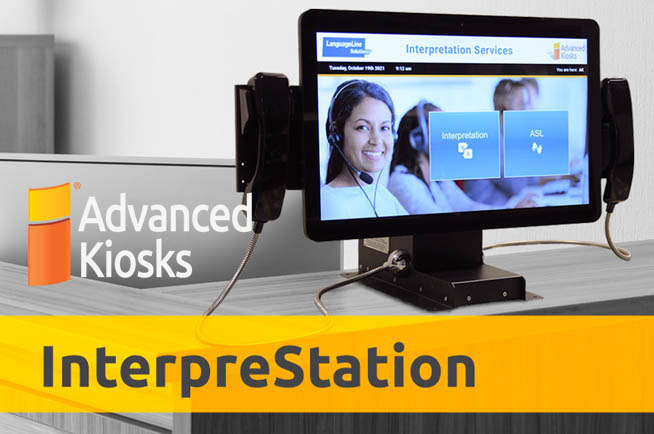
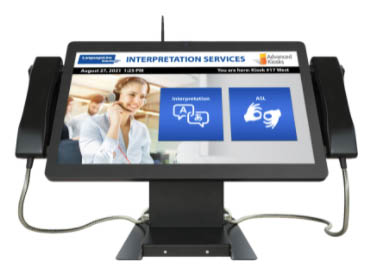
The InterpreStation from Advanced Kiosks allows customers who do not speak English as a first language to ask complex questions and receive answers instantly through a human translator, at a fraction of the cost of hiring an interpreter. By leveraging the services of LanguageLine Solutions, the product offers instant gratification through on-demand interpretation and translation services in 240 languages plus American Sign Language, with weekly usage reports and personal information security that you pay for by the minute.
The hardware features a built-in webcam and 22 inch 4K monitor large enough to capture details including facial expressions and hand gestures. The system includes two VOIP handsets for crisp, clear audio communication.
InterpreStation is an excellent fit for any industry where regular clients may not speak English fluently for complex questions. Hospitals, government facilities, courthouses, universities, and housing authorities are all industries that can benefit from the InterpreStation solution. Communicate to your customer 24 hours a day, seven days a week, and pay by the minute for added convenience and substantial savings.
Click here to learn more!